

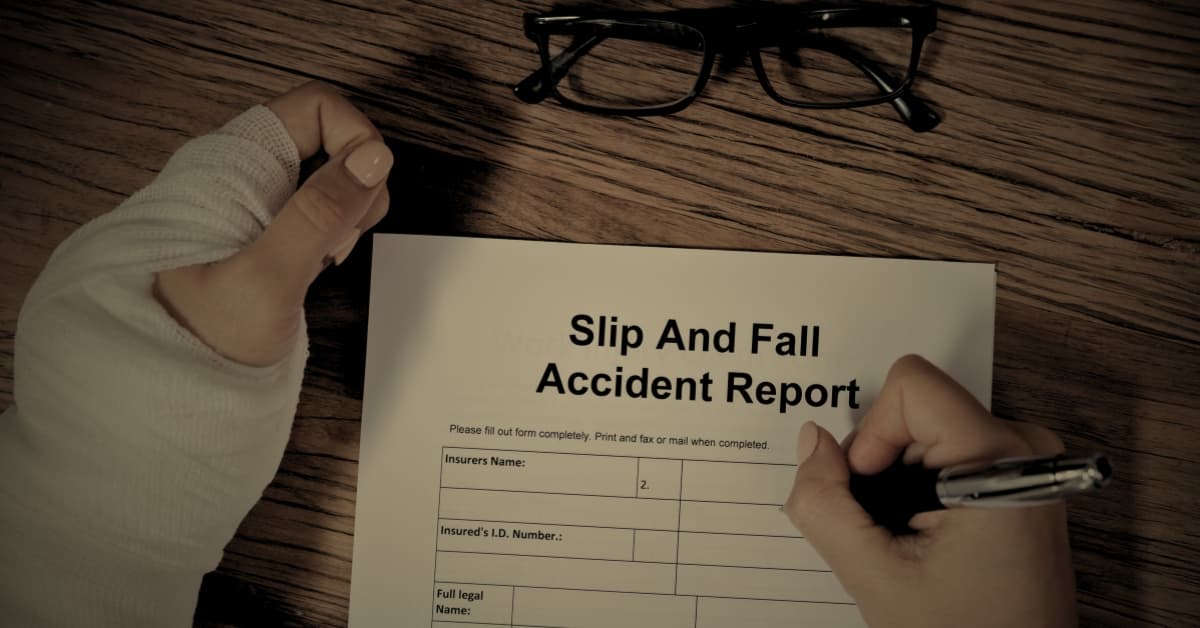
A slip and fall settlement in Florida is rarely a simple number. The question tends to come up early, well before the medical picture is complete. Someone slips on a wet floor in a store, spends an afternoon in an urgent care clinic, and within a few days an adjuster has called and a number has been mentioned. What is a case like this actually worth?
There is no honest answer that fits in a single sentence. These claims are valued case by case, and two people who fall in the same aisle on the same afternoon can end up in very different places depending on how badly each was hurt, what the owner knew about the hazard, and what can still be proven months later. This article explains what generally drives the value of a slip and fall claim in Florida, why published average figures deserve skepticism, and what resolving a claim usually involves.
Overview of Slip and Fall Settlements in Florida
The property owner, or far more often its insurance carrier, agrees to pay an agreed sum, and the injured person signs a release giving up the right to pursue the matter further. Most premises liability claims in Florida resolve this way rather than through a trial. Two features matter more than people expect. A release is generally final, so the claim is closed even if the injury later proves worse than anyone realized. And the number reflects risk rather than justice in the abstract, because each side is predicting what a jury might do and discounting that by the chance of losing outright.
What Constitutes a Slip and Fall Case?
A slip and fall claim is a form of premises liability, the law governing an owner’s responsibility for injuries that happen on the property. The duty owed generally depends on why the injured person was there. A customer in a store or a guest at a hotel is typically considered an invitee. The owner or operator generally must use reasonable care to keep the premises in a reasonably safe condition and to warn invitees of concealed dangers it knew or should have known about.
Florida law adds a specific requirement for the most common category of these cases. Where a person slips on a transitory foreign substance in a business establishment, such as spilled liquid or tracked-in rainwater, the injured person generally must prove the business had actual or constructive knowledge of the dangerous condition and should have taken action to remedy it. Constructive knowledge is generally shown with circumstantial evidence, either that the condition existed long enough that the business should have discovered it in the exercise of ordinary care, or that it occurred with regularity and was therefore foreseeable. That requirement is why many otherwise sympathetic cases fail. A hazard that genuinely existed may not support a claim if nothing shows how long it had been there.
Common Types of Injuries from Slip and Falls
The injuries that follow a fall tend to cluster. Wrist fractures are common because of the instinct to break a fall with an outstretched hand, and shoulder injuries follow the same reflex. Hip fractures are a serious concern for older adults and frequently mark the beginning of a permanent loss of mobility. Knee injuries, ankle fractures, and spine injuries are all regularly seen. Head injuries deserve attention, because someone who strikes the back of the head may feel normal that evening and then develop headaches or difficulty concentrating weeks later. Soft tissue injuries also tend to announce themselves a day or two late, which hands the insurer an argument that something else caused the problem.
Historical Data on Average Settlements
Settlements are generally private. There is no public registry recording what premises claims resolve for in Florida, and confidentiality provisions are common. What gets published comes from sources that are not representative, such as verdict reporters and firm-reported results selected for what they show. An average calculated across a group that includes a bruised elbow and a spinal fusion describes neither.
Comparison of Settlements With and Without Surgery
One distinction does hold up reasonably well. Claims involving surgery generally resolve for considerably more than claims that do not, although surgery by itself does not establish causation or value. Supporting imaging, the medical basis for the procedure, and the operative report provide documentation that is harder to characterize as subjective complaint. Surgery also drives up the cost of care and may support a stronger argument that the injury is serious or permanent. Claims resolved without surgery generally rest on therapy records, imaging that may reflect trauma, age-related findings, or both, and the injured person’s own account of pain and limitation.
Two cautions apply. A surgical recommendation that has not been acted on is not the same as a completed surgery, and carriers evaluate the two very differently. And the cost of care no longer translates as directly into damages as it once did, for reasons discussed below.
Average Settlement for Slip and Fall Cases in Florida
A more useful framing replaces the average with a set of questions. How strong is the proof that the property owner knew or should have known about the hazard? How serious and how well documented is the injury? Is there a credible argument that the injured person bears part of the responsibility? What insurance coverage is available, and is it adequate to the harm?
That last question is a practical ceiling, because a claim is generally worth what can actually be collected. Where the owner is a small business or an individual with a modest policy, the available limits may cap the recovery regardless of how serious the injury is, which is why identifying every potentially responsible party matters.
Key Factors Influencing Slip and Fall Settlements
Severity of Injury
Injury severity is the largest single driver of value, but severity here means documented severity. A fracture confirmed on imaging or a disc herniation with corresponding neurological findings carries weight that a report of persistent pain, standing alone, generally does not. Value also extends beyond treatment already received. Permanent impairment, the cost of future care, lost earnings, and a reduced ability to earn going forward can each be a substantial component. Each requires supporting evidence and, depending on the category and the circumstances, may require medical, vocational, or economic opinion testimony.
Liability and Negligence
Liability is where these claims are usually won or lost. Beyond the knowledge requirement described above, the defense will generally raise the conduct of the injured person. Florida follows a modified comparative negligence approach in most negligence actions, under which a claimant found more than fifty percent at fault for his or her own harm is generally barred from recovering damages at all. Below that threshold, recovery is generally reduced in proportion to the claimant’s share of fault.
That rule gives the defense a strong incentive to build a narrative about distraction, footwear, ignored warning signs, or a hazard argued to be open and obvious. Those arguments do not automatically defeat a claim, and depending on the circumstances a warning may address the duty to warn without resolving whether the premises were kept in a reasonably safe condition. Evidence that a condition was open, obvious, or adequately marked can nevertheless affect comparative fault and exert steady downward pressure in negotiation.
Evidence Collection and Documentation
Evidence in premises cases has a short shelf life. Surveillance video is frequently overwritten on an automatic cycle measured in days or weeks, and inspection and maintenance logs, often the best proof of how long a hazard existed, may not be kept once the ordinary retention period passes. Photographs taken before the hazard is cleaned, the names of witnesses, a copy of the incident report, and a written request that the owner preserve video and maintenance records can change the trajectory of a claim.
Impact of Pre-Existing Conditions
Prior injuries and degenerative changes are a normal feature of these cases rather than a disqualifying one. Florida law generally allows recovery for the aggravation of a pre-existing condition, and imaging showing age-related changes in the spine is common in adults of any age. The difficulty is proving change, which generally requires prior records, a comparison of function before and after, and an opinion from a treating physician. Concealing a prior injury is the worst available option, because the insurer will find it and the credibility damage generally costs more than the prior injury ever would have.
Recent Trends in Slip and Fall Settlements
What Published Settlement Data Can and Cannot Tell You
Published figures illustrate the spread in outcomes. They do not predict a particular result. A responsible valuation looks at comparable outcomes in the same venue involving similar injuries, similar liability strength, and similar coverage, and even that produces a range rather than a number. Venue matters as well, since jury pools differ across Florida counties.
Changes in Laws Affecting Settlement Amounts
Florida’s civil liability landscape has shifted meaningfully in recent years, generally in a direction favorable to defendants and their insurers. The window for filing a negligence lawsuit has been shortened, and the applicable deadline should be confirmed early rather than assumed, because it may depend on when the claim arose. The comparative fault rule described above now generally bars recovery entirely for a claimant found more than half at fault, which has increased the settlement value of fault arguments that once merely reduced a recovery. The rules governing how medical expenses are proven have also tightened, with limits on the use of billed amounts and disclosure requirements for treatment provided under a letter of protection. The cumulative effect is that documentation and preparation matter more than they used to.
Legal Process of Securing a Slip and Fall Settlement
Initial Steps After an Injury
Report the fall to the property owner or manager before leaving, and request a copy of any incident report prepared. Photograph the hazard, the surrounding area, any warning signs present or absent, and the footwear worn. Collect the names and contact information of anyone who saw the fall, including employees. Seek medical evaluation promptly even if the injury seems minor, because the record created in the first days functions as the foundation of the claim.
A few things are best avoided. Recorded statements requested by an insurer shortly after a fall are generally taken to lock in an account before the injury is understood, and there is usually no obligation to give one to the property owner’s carrier. Posting about the incident, or about ordinary activities, gives the defense material it will use. And early offers frequently arrive before the treatment picture is clear.
Importance of Legal Representation
The practical value of counsel is concentrated at the front end. Sending preservation letters before video is overwritten, obtaining records that reveal whether a hazard was recurring, identifying every party with potential responsibility, and locating available coverage are all time-sensitive tasks that shape what the claim can become. Counsel also manages parts of a claim that are easy to underestimate, including potential liens and reimbursement obligations and the timing of a demand so that it is presented once the medical picture is sufficiently developed.
Conclusion: Maximizing Your Slip and Fall Settlement Potential
The value of a slip and fall claim in Florida is not a figure waiting to be looked up. It emerges from the strength of the liability proof, the seriousness and documentation of the injury, the persuasiveness of the response to comparative fault, and the coverage available to pay. Averages published online tell you almost nothing about any of those things.
What an injured person can control is largely a matter of timing. Report the fall, photograph what caused it, get evaluated, follow the treatment plan, and get advice before evidence disappears or a deadline passes. Those steps do not guarantee a particular outcome, but their absence is a reliable way to reduce one.
If you or a family member has been injured in a fall on someone else’s property, the attorneys at The Hernandez Legal Group are available to review the circumstances, explain how Florida law applies to your situation, and pursue the compensation you may be entitled to recover.
This article is for general informational purposes only and does not constitute legal advice. Florida premises liability claims are fact specific, and the duties owed, the evidence required, the effect of comparative fault, the measure of damages, and the deadlines that apply may differ depending on the circumstances of a particular case. If you have been injured in a slip and fall, you should consult directly with a Florida attorney who can review the facts, explain your rights, and advise you on the appropriate next steps.
© 2026 The Hernandez Legal Group wrote and published this article. All rights reserved.